Stevens Institute of Technology Pentagon Badge
Stevens Institute of Technology Professional Education Logo

AI & Emerging Technology

Artificial intelligence is reshaping how we build software, manage organizations, and solve complex problems. From agentic AI systems that can reason and self-correct, to the economic realities of deploying large language models at scale, this rapidly evolving field demands both technical depth and strategic insight.

In our AI & Emerging Technology section, you will find expert perspectives on building reliable AI systems, architectural patterns for enterprise deployment, and the intersection of systems engineering with machine intelligence. Whether you are an engineering leader evaluating AI adoption, a developer building agentic applications, or a researcher exploring the frontiers of autonomous systems, these resources will help you navigate the future of intelligent technology.


Categories:

Will AI Replace Software Engineers? An Honest Assessment

AI tools handle boilerplate, scaffolding, and routine tests, but system design, security, and distributed debugging still require engineers. Here is what the data shows, which roles face real risk, and the skills that compound.

May 14, 20267 min read
Read More
Will AI Replace Data Analysts? Here's What's Actually Happening

AI tools now handle routine SQL, scheduled dashboards, and templated reports. The work growing in demand is question framing, stakeholder communication, and validating AI-generated analysis. Here is what the data shows and which skills to build.

May 14, 20266 min read
Read More
Which Management Jobs Are Most at Risk from AI (And Which Are Safest)

Project coordinators and process-heavy middle managers face the highest automation risk. Strategy, change management, and people leadership roles are most protected. Here is how researchers assess the risk and what determines which side you are on.

May 14, 20266 min read
Read More
The Agentic Shift: Why Reliable AI Depends on Architecture, Not Bigger Models

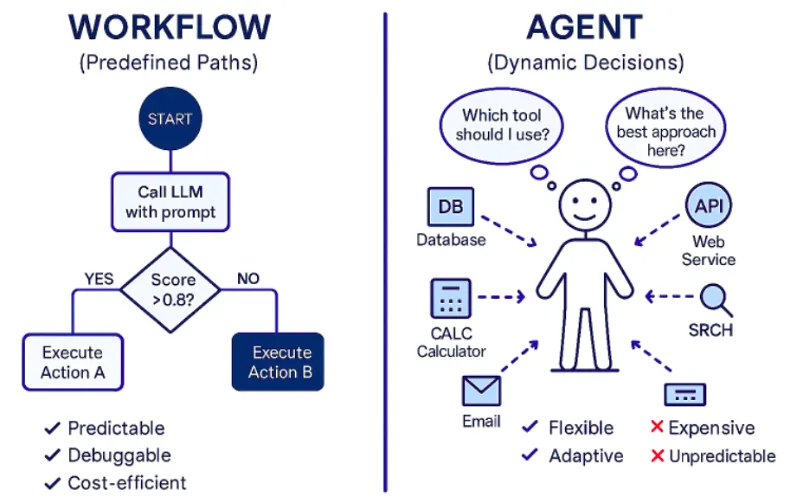
The artificial intelligence landscape is undergoing a fundamental transition. We are moving from stateless, prompt-based interactions to stateful, autonomous agentic systems. This evolution represents a departure from viewing Large Language Models as solitary oracles to treating them as cognitive engines within broader, engineered systems.

Jan 7, 20266 min read
Read More
Building Self-Healing AI: The Orchestrator-Workers and Reflexion Patterns

To operationalize the agentic shift, developers and architects are coalescing around specific design patterns. These patterns solve the fundamental problems of coordination, error handling, and task decomposition that plague traditional AI implementations.

Jan 7, 20267 min read
Read More
The Hidden Economics of AI Agents: Managing Token Costs and Latency Trade-offs

The shift to agentic AI is not just technical. It is economic. The cost model of software is changing from fixed infrastructure to variable intelligence, and engineering leaders must understand the hidden economics that can make or break an AI deployment.

Jan 7, 20268 min read
Read More
Hi! Need help? 👋